The Fakeness of Japanese People?
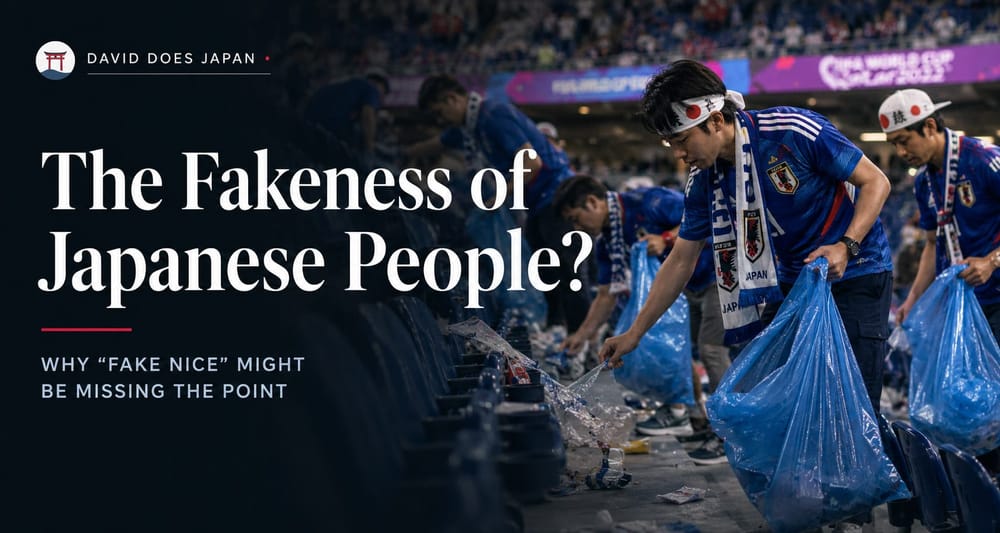
Since all the Japanese people are in America right now and all the stories keep coming up about Japanese people being well behaved and cleaning up after themselves, I felt like this would be a good time to take a look at one of the criticisms I often hear about Japan.
"They're fake nice."
"They don't actually care."
"They're just doing it because it looks good."
There may be some truth to that. A lot of Japan is about image. It's about how you're perceived, and much of that comes from how you present yourself. Either by how you look or how you act.
Everyone Judges
As much as people tell themselves that they're not judgmental and that they don't make assumptions about people, they're either lying or mistaken.
Everyone makes snap judgments because we need to. We don't always have the luxury of fully understanding a situation before we're required to act. It's part of how our brains function.
People constantly evaluate the world around them.
How someone dresses.
How they speak.
How they behave.
Whether we like it or not, those things influence how we're perceived.
Two Different Philosophies
Imagine two groups of people.
One group is taught that they should always be mindful of how their actions affect others.
The other group is taught:
"If people don't accept you for who you are, that's their problem."
That is one of the major differences between Japanese culture and American culture.
Japan places heavy emphasis on how other people perceive you.
America places heavy emphasis on individual authenticity and self-expression.
Neither idea is completely wrong.
But they lead to very different outcomes.
The Problem With Authenticity
America often prides itself on authenticity.
"Be yourself."
"Don't let other people tell you how to live."
"Don't judge a book by its cover."
There is value in that.
But there's also a downside.
Sometimes authenticity becomes an excuse.
"That's just who I am."
"You don't know my story."
"Don't judge me based on one action."
And while that's true to some extent, actions still affect other people.
Eventually every society has to decide where the line is between self-expression and social responsibility.
What If It Really Is Fake?
Let's assume the critics are right.
Let's say Japanese people really are cleaning up after themselves because society expects them to.
Let's say they're being polite because they're worried about appearances.
Does that make the behavior less valuable?
I don't think so.
Because consideration requires effort.
Cleaning up after yourself requires effort.
Being polite requires effort.
Thinking about other people requires effort.
Life is easier when somebody else handles the responsibility.
It's easier when somebody else picks up the trash.
It's easier when somebody else cleans the table.
It's easier when somebody else carries the burden.
So even if some of that behavior comes from social pressure, society still benefits from it.
Why Acknowledgment Matters
One thing I've noticed while spending time in Japan is how often people acknowledge small gestures.
If I move out of the way.
If I hold a door.
If I let someone go ahead of me.
If I accidentally bump into someone.
There's usually a small nod.
A quick apology.
A brief acknowledgment.
Nothing dramatic.
Just enough to communicate:
"I saw what you did."
And honestly, that feels good.
Being acknowledged encourages me to do it again.
It reinforces the behavior.
When nobody acknowledges the effort at all, it's easier to become cynical.
People naturally respond to feedback.
We encourage the behavior we reward.
What Kind of Society Do You Want?
Ultimately, I think people focus too much on whether the behavior is sincere.
The more important question is:
What kind of behavior do you want society to encourage?
Do you want people to think about how their actions affect others?
Do you want people to be considerate?
Do you want them to be mindful of the people around them?
Or do you want everyone to simply do whatever they feel like doing?
The Sweet Spot
The real truth is that the answer is probably somewhere in the middle.
America could probably use a little more social pressure.
Japan could probably use a little less.
The sweet spot is somewhere between the two.
A place where people care enough to make an effort for others, but not so much that they're constantly afraid of being judged.
Because at the end of the day, whether the motivation is kindness, habit, social pressure, or simple politeness, the result is often the same.
The trash still gets picked up.
The apology still gets offered.
The acknowledgment still gets made.
And for the person on the receiving end, that matters a lot more than most people are willing to admit.