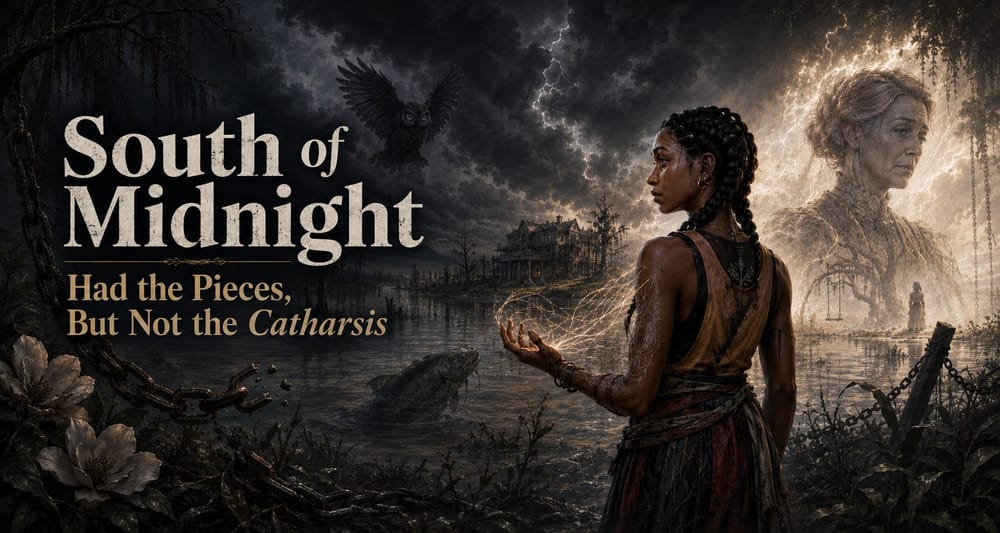
South of Midnight Had the Pieces, But Not the Catharsis
There is a line I keep coming back to when I think about why South of Midnight did not stay with me.
The game mistakes cultural trauma for emotional depth.
That might sound harsh, but I think it gets to the heart of my issue with the game. South of Midnight has a unique setting. It has Southern folklore. It has interesting creature designs. It has family secrets, slavery, grief, magic, and a young girl trying to save her mother after a hurricane. It has a theme of healing generational trauma.
On paper, a lot of that sounds compelling.
But serious subject matter is not the same thing as strong storytelling.
A story is not deep just because it points at suffering. A character is not compelling just because they come from pain. A scene is not automatically moving just because the premise is sad.
The writing still has to earn it.
That is where South of Midnight lost me.
Modern Writers Know the Emotion, But Not the Setup
This is not just a problem with South of Midnight. I think this is a problem with a lot of modern games.
Writers know what is supposed to be emotionally powerful, but they do not always know how to get the audience there.
Your wife died.
Your father is gone.
Your family is broken.
Your people suffered.
You came from tragedy.
Those are powerful ideas, but they are not automatically powerful scenes. The audience still has to know the people involved. We have to understand the relationship. We have to see what was lost. We have to spend enough time with the characters to care when something happens to them.
Otherwise, the game is just handing me an emotional premise and expecting me to fill in the feeling myself.
I had a similar reaction to the beginning of God of War 2018. The game starts with Kratos’ wife already dead. I understand why that should matter to Kratos and Atreus, but as the player, I do not know her. I do not know their relationship. I do not know what she meant to him. I barely know what her face looks like. She means nothing to me.
Then immediately afterwards, I am doing the tutorial section throwing an axe around like a boomerang.
The emotional idea is strong, but the setup is thin.
The Hurricane Opening Breaks the Story Immediately
South of Midnight has the same problem, maybe even worse, because it starts with what should be an urgent, frightening disaster.
A hurricane is coming.
Hazel is worried about her mother.
They need to evacuate.
That should be simple. That should be tense.
That should immediately focus the story.
Instead, the writing keeps getting distracted.
Hazel’s mother finally comes home, and instead of the scene staying focused on the evacuation, they start having casual banter. There is a joke about running shoes. Then suddenly they are arguing about Hazel’s grandmother and her father. Then Hazel’s mother tells her to go check on the neighbors.
Why?
A hurricane is coming. They are supposed to be leaving.
Hazel goes to check on the neighbors, and they are not evacuating. They are just going to ride it out. So now the game has already undercut its own danger. Is this storm serious or not?
Then the old lady invites Hazel inside. She is cooking. Hazel says she cannot say no to home-cooked gizzards. They start talking. Then, while Hazel is away, her mobile home gets swept away with her mother inside.
That is the inciting incident of the entire game.
But instead of feeling dramatic, it felt absurd.
A story can ask me to accept magic. It can ask me to accept folklore. It can ask me to accept giant fish, ghosts, monsters, and supernatural forces.
But it cannot ask me to ignore basic common sense.
If there is a deadly hurricane coming, characters need to act like there is a deadly hurricane coming.
That opening scene should have been about fear, urgency, and helplessness. Instead, it feels like the writers wanted to squeeze in banter, family tension, local flavor, food jokes, and emotional exposition all at once.
The result is that nothing lands properly.
Folklore Is Not Automatically Compelling
After playing the game, I looked into some of the folklore it was using. A lot of it is real. Huggin’ Molly, giant fish stories, strange creatures, owl-like figures, and other regional myths are part of Southern folklore.
That part is interesting.
But I also started wondering why this kind of folklore has not been used more often in mainstream media.
These stories have existed for a long time. Some of them go back hundreds of years. But compared to Japanese folklore, Korean folklore, or even something like Baba Yaga from Russian folklore, Southern folklore has only been used sparingly.
Why is that?
I do not think the answer is simply that people are ignoring it. I think part of the issue is that a lot of these stories came from very specific regional fears.
Swamps.
Forests.
Alligators.
Bridges.
Children wandering too far.
Travelers getting lost.
Strange noises in the dark.
People disappearing.
A lot of folklore begins as a way for people to explain danger. It warns children not to go somewhere. It warns travelers not to take certain roads. It gives shape to things people are afraid of but cannot fully control.
That works for the people in that region and that time period.
But the question is: how does that connect to people now?
Most people do not live in swamps. Most people do not fear alligators. Most people are not worried about crossing some rural bridge at night or getting lost in the woods.
That does not mean the folklore has no value. It means the story has to do extra work to translate it into something universal.
This is where Japanese folklore and urban legends have often been more successful. A lot of those stories have been modernized. They show up in schools, apartments, bathrooms, trains, phones, mirrors, bedrooms, and under the covers.
Everyone understands hiding under the covers.
Everyone understands being scared in their own home.
Everyone understands the feeling of a school ghost story.
That is the difference.
The folklore is not just old. It has been adapted into spaces people still live in.
With South of Midnight, I liked that it was pulling from Southern folklore. I liked seeing something different. But uniqueness is not enough. The game still has to make those stories feel emotionally relevant to the player.
A giant fish can be cool.
Huggin’ Molly can be cool.
A man turning into an owl can be cool.
But “cool and unique” does not automatically make something memorable.
The story still has to make me feel why it matters.
Cultural Trauma Is Not Emotional Depth
This is where the larger issue comes in.
South of Midnight is clearly interested in the idea of generational trauma. It is interested in inherited wounds. It is interested in the way pain gets passed down through families and communities. It is interested in the history of slavery, oppression, grief, resentment, broken families, and people who cannot move on from the past.
That is valid subject matter.
But I am tired of stories that only know how to remind people that the wound exists.
Yes, slavery happened. Yes, Black people suffered. Yes, generational trauma exists. I am not denying any of that. But constantly reminding the audience of suffering is not the same as telling a meaningful story about overcoming it.
At some point, someone has to break the chain.
That is the part missing from South of Midnight.
If the story is about inherited wounds, then show someone refusing to pass the wound down.
If the story is about healing, then show healing.
If the story is about generational trauma, then give me a character who becomes something more than the trauma.
Instead, the game often feels like it is affirming that these characters will never truly break out of it. The story keeps circling the same ideas: oppression, grief, resentment, family pain, evil white people, music, dancing, inherited suffering.
Those things can be part of a story.
But they cannot be the whole story.
A story needs movement. A story needs transformation. A story needs some kind of release.
That is why I think Anime has connected with so many people in America. Not because Americans truly understand Japan, but because the emotional themes are easy to identify with.
Wanting to become strong.
Protecting your friends.
Chasing a dream.
Proving yourself.
Doing the right thing.
Being late for school.
Enjoying a delicious meal.
Wanting to be seen.
Wanting to become someone better.
Those are universal.
People can enter those stories even if they do not share the culture.
That is what South of Midnight struggles with. It has culture. It has history. It has pain. But it does not always turn those things into a universal emotional journey.
It asks the player to care because the subject matter is serious.
But serious subject matter still has to become a story.
Bunny Is the Better Story **SPOILERS**
The most frustrating part is that the game actually has the pieces for a stronger story.
Bunny is probably the clearest example.
Her motivation is simple and powerful: she lost her daughter and cannot let go.
That grief becomes destructive. It does not just stay inside her. It spreads outward. It hurts other people. It becomes the source of so much of the suffering in the game.
That is a good tragic setup.
But the problem is that the game does not resolve it in a teachable way.
By the end, Bunny still does not let go. She chooses to live in the dream world because she cannot move on. She chooses the fantasy. She chooses the illusion. She chooses the place where she does not have to fully accept what happened.
So where is the catharsis? Where is the healing?
You take the character who has "suffered" the most and instead of healing them, you let them lie to themselves.
If the game is about inherited wounds, then someone has to stop inheriting them.
If the game is about grief, then someone has to face grief.
If the game is about letting go, then someone has to let go.
Bunny does not.
And maybe even worse, Hazel does not really save her.
That might be what bothers me most.
Hazel is supposed to be the hero. She is the one we look to for moral guidance. The one who will do the right thing even when the right thing is the difficult choice. But Hazel does not function like this. She is not the person who breaks the cycle.
In fact, Hazel is actually the one who delivers Bunny to the Devil.
Roux cannot give the offer to Bunny directly. Hazel has to bring it to her, the offer comes in the form of the brush. Hazel does it without much hesitation. She tells Bunny to let go, the words come out but doesn't hold any more weight other than that.
"Leave the trauma behind"
Hazel turns her back and walks away. Not a tear is shed as Bunny walks off with the Devil. I guess it's okay cause she deserves it. Or because she was a bad person. The loss of her daughter isn't considered real trauma worth healing.
That makes Hazel part of the mechanism that allows Bunny to remain trapped.
Instead of Hazel rescuing Bunny from her grief, she helps create the final temptation that lets Bunny escape into it.
That is a strange role for the hero. It is especially strange for a Weaver, someone whose job is healing trauma.
Can we only heal people we like?
Or people who are not the “evil white lady”?
What makes it even more tragic is that there seemed to be a genuine connection between Bunny and Hazel.
In the opening scene, when the hurricane is approaching, Hazel’s first recommendation is to go to Bunny’s house.
“Let’s go to the mansion with hurricane-proof windows.”
Hazel genuinely wants a connection with Bunny because she is one of the only connections to her now-deceased father. Hazel does not understand the hate her mother has for her mother-in-law. She complains about it, and you can tell she genuinely wants to understand why. Her mother doesn't want to talk about her father, so maybe Bunny will.
There are even moments where Bunny shows real concern for Hazel, even though they could not visually look more different from each other. Bunny is an upper-class white Cruella de Vil-looking character. Hazel is her nose-ring-wearing high school granddaughter.
It is quite the odd couple.
But I found that to be the most interesting part.
This old white lady showing concern for her Black granddaughter, and the granddaughter desperately wanting to be part of the grandmother’s life in order to connect to some semblance of family.
That was interesting.
The obvious “evil rich people are bad” trope is played out. The mother who hates her mother-in-law is played out too. I saw the “she is actually evil” turn coming a mile away.
I kept thinking the game was going to go in a different direction since it kept hinting at this relationship between Bunny and Hazel.
Lo and behold, nope.
She actually was evil the entire time.
Driven to desperation by... trauma.
It makes the ending feel hollow. Not because every story needs to be happy, but because a story like this needs catharsis. It needs some kind of emotional release. It needs someone to make a difficult choice that means something.
Instead, Bunny remains inside the wound.
The writers expect you to give Hazel a pass because she did not push Bunny to make the decision. But she also did not really try to save her either.
It is not her problem.
But then what is the point of being a Weaver?
I found it ironic that a game about healing trauma and letting things go essentially does the opposite.
The game does not heal the trauma.
It preserves it.
I think there is a larger message here at play. I am sure it was not intentional by the developers. I guarantee that. They are not clever enough for this to have been the message.
I will not explicitly say what I am referring to, but for those of you smart enough to put it together:
If you want to heal from trauma, you have to let it go.
You can accept that it happened. It can be part of you. It can be what shapes who you are. But it cannot be what is always brought up during talking points. It cannot be a convenient scapegoat for everything that is going wrong in your life or in your community. You can't make a metaphorical villain the heart of all your problems. You'll need to forgive them and accept them as an undeniable part of your future life. Constantly bringing up the past can't be what defines you.
And if you cannot let it go and find a way to move past it, then you will end up like the ending in South of Midnight.\
The Better Ending Was Right There
The stronger version of Bunny’s ending seems obvious to me.
Hazel should have been the reason Bunny is finally able to move on.
At the beginning of the game, Hazel already seems to have some connection to Bunny. Her mother does not want her around Bunny, but Hazel’s first instinct during the storm is still to go to Bunny’s house. That matters.
Hazel wants that connection.
And it makes sense. Hazel’s father was Bunny’s son. So if Hazel misses her father, Bunny is one of her strongest remaining links to him. And the other way around, Hazel is Bunny’s only connection to family she has left.
That should have been the emotional bridge.
Bunny lost a daughter, but she still has a granddaughter.
That is the story.
Hazel should not replace Bunny’s daughter. But Hazel could remind Bunny that there is still living family in front of her. Bunny’s life is not over. Her love does not have to remain trapped in the past. Her grief does not have to keep destroying everyone around her.
That gives Bunny a real final choice.
Does she choose the dream of the daughter she lost?
Or does she choose the granddaughter who is still alive?
That is catharsis.
That is a real emotional dilemma.
That would make Hazel matter. That would make Bunny’s grief matter. That would make the theme of generational trauma actually resolve.
Bunny does not need to stop loving her daughter. She does not need to forget her. She just needs to accept that love for the dead cannot come at the cost of abandoning the living.
Hazel should have been the living person who brings Bunny back.
That would make Hazel a hero.
Not because she beats the monster.
Not because she wins the fight.
But because someone finally breaks the chain of suffering.